


Dear 2G’s!
I want to let you know about my recently published paper, reporting about the responses of 2G’s to the October 7 massacre and the rise in antisemitism in North America since then. The paper, entitled “Conjuring up ancestral specters: Post-October 7 attack psychological reactions in offspring of Holocaust survivors“. was published in the peer-reviewed journal “Psychological Trauma – Theory, Research, Practice, and Policy” of Division 56, the Trauma Division at the American Psychological Association. The American Psychological Association has been extremely biased and invalidating of the concerns of it Jewish members, as evidenced by chilling data in the recently published report by the House Committee on Education and Workforce. It is therefore a particularly meaningful accomplishment to have this paper published by this journal, to offer a different perspective.
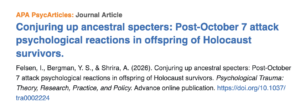
I am deeply grateful to many of you who so generously gave of your time to participate in the research project. The journal issue with the paper is only available to those with a subscription, or access to university libraries or other similar resources that provide access. However, here is brief summary of some of the findings:
The study focused on the psychological impact of the October 7, 2023, attacks and the subsequent rise in antisemitism in North America. The findings indicate that descendants whose parents experienced the Holocaust (especially 2G’s who felt their parents suffered from post-traumatic symptoms), reported higher levels of psychological distress than participants whose parents had not experienced the Holocaust. A very significant aspect of the findings was that the experiences of the participants in their life in North America since October 7 have changed dramatically, and these changes have been associated with negative effects on their psychological well-being. Exposure to antisemitism through the media and in one’s daily life, and increased sense of threat to one’s safety due to being Jewish, were associated with significant increases in psychological distress.
While the observations about the elevated levels of distress among 2G’s, which are higher even in comparison with non-Holocaust related Jewish people, are troubling, they are important in validating the personal experience many of us have in these times. That is to say, those of us who feel the negative impact of the exposure to antisemitism through the media, in their town, and in their professional and social circles, should know they are not alone, and these negative responses are not a personal frailty, but rather reflect a public health threat to a large part of the Jewish population in the diaspora. ,
This type of empirical evidence is important since antisemitism and invalidation of the Jewish experience have become so pervasive and normalized, including by professional associations such as the American Psychological Association (see this link for more information), the Social Workers Association (see this link), and in medical settings (see this video).
It is important to be able to document incidents, assaults, exclusion and discrimination because only aggregate data can serve to record and substantiate the reality of large-scale phenomena. It is necessary to present hard data to refute pervasive invalidation and denial of the harm being caused to Jewish Americans and Canadians.
With gratitude,
Irit
Leave a Reply